History of the Old Faithful Inn
Now entering its second century . . .
| (For More on the Inn's 2004 Centennial Celebration and Photos of May 7 Opening Day Ceremonies Click Here) |

| (above) Early postcard view by Matteson Postcards, postmarked 1909. |
| I built it in keeping with the place where it stands. Nobody could improve upon that. To be at discord with the landscape would be almost a crime. To try to improve upon it would be an impertinence. Spoken by Robert Reamer, architect of the Old Faithful Inn, during construction of another notable building he designed for Yellowstone, the Canyon Hotel. His style of architecture, which designed the building to fit into the landscape, is called "rustic architecture" or "parkitecture." |
Content and scanned images on these pages © Frank Markley.
THE DECISION TO BUILD THE OLD FAITHFUL INN
In Yellowstone's early years, great railroads such as the Northern Pacific saw profits in promoting package "coupon"
tours of the park. For about $40, an early twentieth-century tourist could purchase a five-day tour. Arriving by rail at the
northern Gardiner entrance, "couponers" were taken by horse-drawn stagecoaches to Mammoth Hot Springs to spend
the night at the National Hotel, and from there on to other park hotels, finally to return to Mammoth. Originally the first
stop after Mammoth was the Fountain Hotel, which stood near the present Fountain Paint Pots area of Yellowstone.
After their first night at Fountain, guests were taken to the Upper Geyser Basin, location of Old Faithful, Beehive, Castle,
Grand, and many more of the park's outstanding geysers and thermal features. The party returned to Fountain Hotel for
a second night, and made one more stop at the Upper Geyser Basin the next day on their way to Lake Hotel.
Many of these generally upscale couponers expressed a desire to spend more time in the Upper Geyser Basin, and
requested overnight accommodations there. In 1885 a large, rambling, plain-frame hotel dubbed the "Shack" was built,
remaining until 1894. It was said that guests got splinters from the unfinished walls and that the building shook with
each step. Preferring couponers to return to Fountain Hotel for a second night, the touring company discouraged
patrons from all-night stopovers at the Upper Geyser Basin, allowing it only if everyone in the coaching party agreed to
the stay at extra expense.
In Yellowstone's early years, great railroads such as the Northern Pacific saw profits in promoting package "coupon"
tours of the park. For about $40, an early twentieth-century tourist could purchase a five-day tour. Arriving by rail at the
northern Gardiner entrance, "couponers" were taken by horse-drawn stagecoaches to Mammoth Hot Springs to spend
the night at the National Hotel, and from there on to other park hotels, finally to return to Mammoth. Originally the first
stop after Mammoth was the Fountain Hotel, which stood near the present Fountain Paint Pots area of Yellowstone.
After their first night at Fountain, guests were taken to the Upper Geyser Basin, location of Old Faithful, Beehive, Castle,
Grand, and many more of the park's outstanding geysers and thermal features. The party returned to Fountain Hotel for
a second night, and made one more stop at the Upper Geyser Basin the next day on their way to Lake Hotel.
Many of these generally upscale couponers expressed a desire to spend more time in the Upper Geyser Basin, and
requested overnight accommodations there. In 1885 a large, rambling, plain-frame hotel dubbed the "Shack" was built,
remaining until 1894. It was said that guests got splinters from the unfinished walls and that the building shook with
each step. Preferring couponers to return to Fountain Hotel for a second night, the touring company discouraged
patrons from all-night stopovers at the Upper Geyser Basin, allowing it only if everyone in the coaching party agreed to
the stay at extra expense.
But the well-heeled guests included many who
were accustomed to luxurious European resorts
or America's Catskills, Sarasota Springs, and
other upscale vacation retreats. They expected
more. In response to this demand, and thanks to
a recently passed park regulation allowing
construction of buildings within an eighth of a
mile of natural attractions, Harry Childs, part
owner of the Yellowstone Park Association, with
financial loans from the Northern Pacific
Railroad, contacted 29-year-old west coast
architect Robert Reamer in 1902 to design and
build the Old Faithful Inn as a first-class hotel in
the Upper Geyser Basin.
CONSTRUCTION BEGINS
Construction of the Old Faithful Inn was begun in
1903 (probably spring or early summer) and
scheduled to be completed by opening of the
tourist season in June 1904, requiring work to
continue through Yellowstone's severe winter.
The former site of the Shack was chosen for the
new hotel--a site just a little west of the large pine
tree under which President Arthur had camped in
1883. Young architect Robert Reamer, called "the
kid" by Childs, supervised nearly everything done
and designed nearly everything used. In the end,
construction costs have been estimated at
between $120,000 and $200,000, with one recent
source placing actual costs at $140,000, with
about $25,000 additional for furnishings. The Inn
would be built on time for its June opening, and it
would become a model of "park architecture"--an
influence reflected in many of our national parks'
grand hotels.
Reamer began construction with a crew of over
40 laborers, many thought to have been
experienced raiload trestle builders. They most
likely started by building the 500-ton
chimney/fireplace as a central support for the rest
of the lobby. This structure had four large hearths,
one on each of its four largest sides, and four
small hearths on the four smaller corners. It was
built from rhyolite, as was the Inn's stone
foundation, quarried about five miles from the
building site. Rhyolite is an igneous rock, born of
the same volcanic upheavals that formed
Yellowstone's caldera--a fitting building material
for a hotel that rests on thermal ground warm
enough for guests to still sometimes find the
"cold" water to be a comfortable bath temperature.
With the chimney/fireplace as its central support,
the lobby rose to a height of nearly 76-1/2 feet,
mostly constructed of lodgepole pine harvested
nearby. Lodgepole pine grows exceptionally
straight and at a fairly even width, and was a
preferred choice for log cabins in the American
West. Workers may have found Yellowstone's
heavy snows an advantage in pulling timber and
stone to the building site.
Details of the progress of construction are still
not completely known, and a photo showing
construction workers at the site with framing well
on its way and no snow on the ground leads
historians to believe much of the exterior may
have been in place before the onset of winter.
The lobby would have undoubtedly provided
welcome shelter for laborers as well as
fireplaces that could be used for cooking,
warmth, and a blacksmith's forge. Ironically,
when Yellowstone's cold winter came, the
enclosure may have trapped in the night's often
subzero temperatures, remaining a dark icebox
as daytime outdoor temperatures
rose.
were accustomed to luxurious European resorts
or America's Catskills, Sarasota Springs, and
other upscale vacation retreats. They expected
more. In response to this demand, and thanks to
a recently passed park regulation allowing
construction of buildings within an eighth of a
mile of natural attractions, Harry Childs, part
owner of the Yellowstone Park Association, with
financial loans from the Northern Pacific
Railroad, contacted 29-year-old west coast
architect Robert Reamer in 1902 to design and
build the Old Faithful Inn as a first-class hotel in
the Upper Geyser Basin.
CONSTRUCTION BEGINS
Construction of the Old Faithful Inn was begun in
1903 (probably spring or early summer) and
scheduled to be completed by opening of the
tourist season in June 1904, requiring work to
continue through Yellowstone's severe winter.
The former site of the Shack was chosen for the
new hotel--a site just a little west of the large pine
tree under which President Arthur had camped in
1883. Young architect Robert Reamer, called "the
kid" by Childs, supervised nearly everything done
and designed nearly everything used. In the end,
construction costs have been estimated at
between $120,000 and $200,000, with one recent
source placing actual costs at $140,000, with
about $25,000 additional for furnishings. The Inn
would be built on time for its June opening, and it
would become a model of "park architecture"--an
influence reflected in many of our national parks'
grand hotels.
Reamer began construction with a crew of over
40 laborers, many thought to have been
experienced raiload trestle builders. They most
likely started by building the 500-ton
chimney/fireplace as a central support for the rest
of the lobby. This structure had four large hearths,
one on each of its four largest sides, and four
small hearths on the four smaller corners. It was
built from rhyolite, as was the Inn's stone
foundation, quarried about five miles from the
building site. Rhyolite is an igneous rock, born of
the same volcanic upheavals that formed
Yellowstone's caldera--a fitting building material
for a hotel that rests on thermal ground warm
enough for guests to still sometimes find the
"cold" water to be a comfortable bath temperature.
With the chimney/fireplace as its central support,
the lobby rose to a height of nearly 76-1/2 feet,
mostly constructed of lodgepole pine harvested
nearby. Lodgepole pine grows exceptionally
straight and at a fairly even width, and was a
preferred choice for log cabins in the American
West. Workers may have found Yellowstone's
heavy snows an advantage in pulling timber and
stone to the building site.
Details of the progress of construction are still
not completely known, and a photo showing
construction workers at the site with framing well
on its way and no snow on the ground leads
historians to believe much of the exterior may
have been in place before the onset of winter.
The lobby would have undoubtedly provided
welcome shelter for laborers as well as
fireplaces that could be used for cooking,
warmth, and a blacksmith's forge. Ironically,
when Yellowstone's cold winter came, the
enclosure may have trapped in the night's often
subzero temperatures, remaining a dark icebox
as daytime outdoor temperatures
rose.
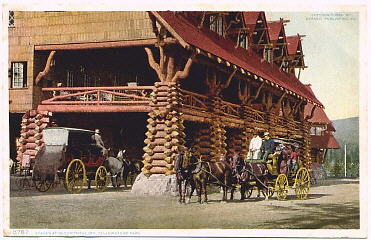
| (above) Detroit Publishing Co. (c) 1906 |
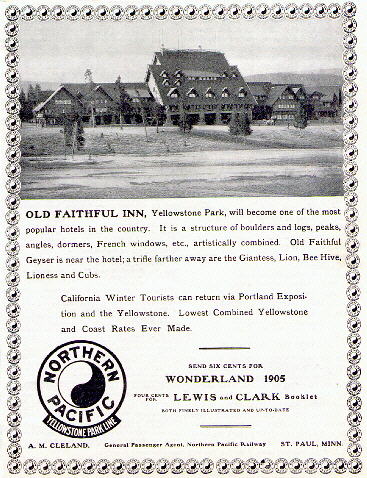
(above) This advertisement appeared in the March 2, 1905 edition of "The
Youth's Companion," promoting the Northern Pacific Yellowstone Park Line
to the Old Faithful Inn, then in its second season.
Youth's Companion," promoting the Northern Pacific Yellowstone Park Line
to the Old Faithful Inn, then in its second season.
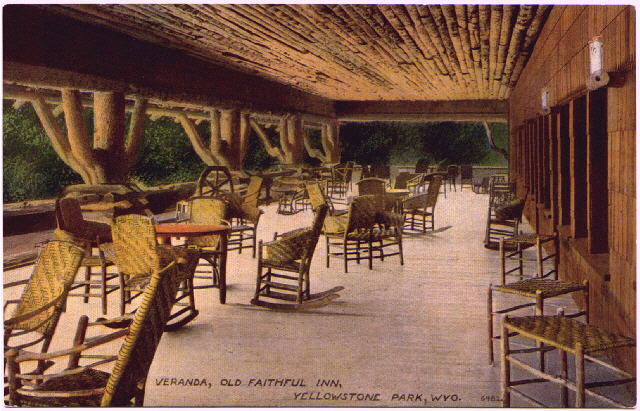
(above) Veranda, Old Faithful Inn (Pub. by The Acmegraph Co., Chicago).
Note that some artistic license was taken in placing this scene in a forest
setting. Then as now the view from the veranda was unobstructed.
Note that some artistic license was taken in placing this scene in a forest
setting. Then as now the view from the veranda was unobstructed.
