| A Trip to Yellowstone National Park 1988 Late August / Early September Yellowstone's Summer of Fire by Frank Markley |
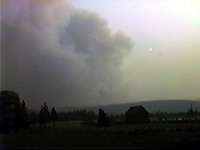
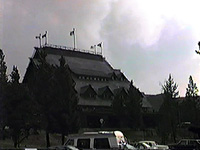
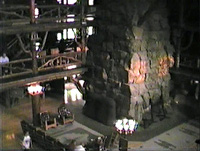
About the Photos: Except where noted, all photos were taken during my 1988 Yellowstone trip. Most were 35mm photos, however some views are
screen captures taken from my videotape. Please click on the thumbnails in the right margin for larger views and text.
screen captures taken from my videotape. Please click on the thumbnails in the right margin for larger views and text.

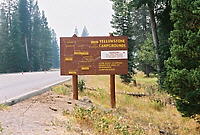
| Map on wooden sign at east entrance shows closed campgrounds (Tu) 8-30-88 |
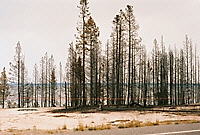
| Recently burned area near Thumb Geyser Basin (Tu) 8-30-88 |
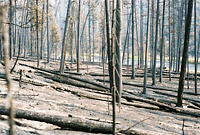
| Aftermath of recent fire at Gibbon Falls picnic area (W) 8-31-88 |
Saturday, August 27
The day was spent driving from my apartment in Loudonville, Ohio to my
first night's rest at Rochester, Minnesota. When I left early this morning, I
saw one of the house painters who has been painting our house the past
week or so getting ready for his day's work. He saw me putting some things
in the car and asked where I was headed. I just told him "out west" and he
said he had heard the fires were getting pretty bad in Yellowstone Park. I
told him that's what I had heard too--a little embarassed to tell him where I
planned to spend most of my time. It was a long day of driving, and it felt
good to finally reach my reserved room in Rochester, Minnesota around
10PM central time.
Sunday, August 28
I got up around 8:30AM, went out to eat, and left Rochester, Minnesota,
about 10:30 AM. The day was spent traveling across Minnesota and most
of South Dakota to Sturgis, where I am staying this second night of my
vacation.
It was sunny and cool all day, so travel was not as tiring as it sometimes
can be. The sunset (from about 8:00 PM here) was even and pretty as an
orange glow lined the bottom of the deepening-blue sky.
Monday, August 29
After breakfast at the Boulder Canyon Restaurant in Sturgis, SD, I returned
to my room to try to decide whether I should travel on to Yellowstone or to
Denver/Estes Park. The news during my trip so far has not been
encouraging as reports of road and area closings and firefighting activity
are broadcast hourly over my car radio.
I made a few calls to Colorado asking about room vacancies, learning that
rooms were still open in Estes Park for tonight and the week to come. But I
couldn't leave my room without once again calling Yellowstone to ask about
road closures. The young woman at reservations said all but the south
entrance are open, and that there is currently car access to the Grand
Canyon of the Yellowstone. All opening and closings are, she stressed,
tentative. It was almost checkout time, and I had to get out of the room and
on the road soon, so I spent the next ten minutes or so thinking it over, and
finally decided that I had come this far, this would undoubtedly be an
experience of a lifetime no matter how it turned out--even if I could stay
there only a day or two. Yellowstone it was. I would continue as planned
since, at least at this point in time, I could still reach my intended
destination, Yellowstone's Old Faithful Inn, via the east entrance. About
11:30 AM I left for Cody, and got there around 7:30 PM. Near Buffalo,
Wyoming, I could see columns of smoke from what I found out were six
different forest fires in the Bighorn Mountains. Haze greatly diminished the
view of distant mountains and valleys. To my surprise, there was no
noticeable scent of burning wood in the air, even as I reached Cody. But
the haze of smoke was thick enough that the glow of the 6PM sun could be
observed comfortably with the naked eye just as it could at sunset, though
its position was much higher in the sky.
Tuesday, August 30
This morning I drove the road from Cody to Yellowstone's east entrance.
Although I have often enjoyed this route's exceptionally scenic beauty in
the past, today the visibility is poor with a smoky haze that resembles
clouds and rain.
Once at Yellowstone, I was charged no entrance fee "because of the
fires," the rather cheerful attendant explained. Mine was the only car at the
gate, and the atmosphere there seemed rather informal and unofficial. For
awhile, all looked untouched by fire as I passed forests, rivers, rocky
hillsides, and lakes. But it was quickly apparent everything was not
"business as usual."
My first stop was the stately, sprawling Lake Hotel. I walked through the
open door of the rear entrance to find furniture covered and workmen busy
making renovations inside and out. Though the hotel was scheduled to be
open at this time, the lack of paying overnight guests forced a premature
closing of this historic 19th century facility. Great columns of white smoke
arose in the distance across Yellowstone Lake, the largest coming from the
Old Faithful area and widening in the sky overhead as it passed into the
hazy east. At 3PM, the sun shone as a distinct glowing dull orange disk
through this massive cloud of smoke, tipping the waves on Yellowstone
Lake with a fine deep-orange-colored trim.
As I drove along the western edge of Yellowstone Lake near the West
Thumb area, I saw charred standing and fallen trees lining the roadside. In
some places, red plastic ribbon was stretched across pulloffs to protect
curious motorists from the dangers of often-hidden smoldering areas or
falling snags.
Blue sky could occasionally be seen--though somewhat hazy--in many
areas as I worked my way through the park. The soft glow of the afternoon
sun as it filtered through the smoke gave the entire area a misty, amber
haze that suggested the overcast of a rainy day, but without the steely
gray and dampness.
Bus loads of tourists continue to arrive at the Old Faithful complex. But
there is no doubt the crowds are smaller than in years past. Loss of
attendance, not the fires directly, has caused the premature closings of
Lake Hotel, Canyon Lodge cabins, Snow Lodge, Old Faithful Lodge
and--disappointing to me--its cafeteria. Dining throughout the park is
limited to meals in the dining halls at Old Faithful Inn and Mammoth Hotel,
the cafeteria at Lake Lodge, and lunch counters at the Hamilton Stores.
I would not recommend Yellowstone this year for a first-time visitor. It is too
hazy and too many facilities are closed. But I have seen Yellowstone in
more favorable years, and I wanted to see this natural phase of its
existence. The constant odor of burning pine indoors and out is at this
point not unpleasant. In more heavily used areas throughout the park, a
taped message plays continually at the end of the AM dial. It tells us the
forest has seen major fires about every 300 years. The last great
Yellowstone fires were in the 1600s or 1700s. In an ecological sense, we
are told, the fires are good because they allow new growth: new meadows
will encourage new species that disappeared from the park long before our
time.
The evening's activities at Old Faithful Inn, where I am staying, seem
strangely unaffected by the natural outdoor events that surround us.
Though the fires provide ready and frequent conversation for strangers,
the laughter of good company and fussing of travel-weary babies continue
as they have since the park opened many years ago. Here, on this
late-summer evening, there is no apparent fear or anxiety caused by the
fire which burns in a valley just a few miles away. We are told the fires
become less active at night, and I think most of us believe we would be
notified if any immediate danger threatened. We feel a comradeship in the
shared experience of perhaps being looked upon with a degree of
suspicion by our friends and acquaintances when they learned we chose
Yellowstone as this year's vacation destination. But we know to ourselves
we feel safe tonight. Without expressing it there is a degree of excitement
in the air that we will not be able to fully describe when we get home. We
are glad we are a part of it. We are surrounded by others who took a
degree of risk coming here. Many of us here this evening have gone
outside and looked toward the west to see if we can really see flames or a
glow from the North Fork fire that burns in the not-too-distant valley behind
us. Would it be as we pictured it earlier this summer as we listened to news
reports and tried to visualize the scene for ourselves? But on this evening
and at this location, we see no flames and no glow. The haze of the air
obscures visibility and the geographical placement of the fire hides all but
its unmistakable smoke. Now we know.
Wednesday, August 31
With increasing breezes, yesterday's haze has been swept away and all
appears somewhat brighter, though certainly not clear. This morning when
I stopped at the Old Faithful Visitor Center I learned that the Canyon area,
my intended destination, is now closed. A map on the information counter
shows areas currently open in the park. Based on this, I decided to go to
Norris Geyser Basin today, keeping in mind the rangers' warnings that
roads can close at any time. They suggest motorists carry along essential
items in case of unexpected long-term delays.
During today's drive I saw much more evidence of the fire's influence than I
had seen yesterday. Fountain Flat Drive, which runs through a large, level,
open area, has been closed and is now being used as a temporary
heliport. As I continued driving north, I passed Madison Junction, where a
firefighter base is visible from the Grand Loop road. Rows of simple green
pup tents hug the ground amid occasional clotheslines. A handful of
firefighters remained at the camp. From Madison to Norris, I passed many
areas where fires have burned to the edge of the road. In the woods
across from the Gibbon Creek picnic area, I saw smoke rising and the
flames of a few unchecked ground fires. About a half hour later, fire trucks
came up the road in the direction of this burning area. Visitors are advised
not to be overly concerned at the sight of unattended fires; rangers and
other personnel, we are told, constantly patrol the park and are on the
lookout for these developments.
When I reached Norris Junction, there was a roadblock in front of the
access road to the geyser basin. Two park employees--one seated in a
folding chair--were in the middle of the road near the four-way intersection,
where they provided information to passing motorists. The man in the
folding chair told me fires are still being extinguished in the area, and that
they expect Norris Geyser Basin to reopen tomorrow.
I was disappointed with the news of the closing, and slowly worked my way
back toward the Old Faithful area. In midafternoon, I stopped along the
Gibbon River to rest on a large riverside boulder and have lunch. The
rapidly flowing river was peaceful and strangely beautiful in spite of the
ever-present haze and clutter of charred tree trunks across the stream.
Occasionally helicopters flew overhead, towing suspended canisters of
water or fire retardant to the backcountry.
The Gibbon Falls picnic area was particularly devastated by recent fire.
What remains offers no hint of the beauty of the formerly wooded spot.
The ground is spongy with light gray ash--its loosely packed, lifeless
surface easily disturbed with a kick of the foot. It reminded me of the
days-old remains of a huge campfire. Charred trees are strewn throughout
the area. Many have fallen across the barren landscape, while others
stand awaiting their inevitable fall. The scene here is strangely silent,
disrupted only by the sound of the nearby rushing river and the buzzing of
occasional insects that seem to enjoy the forbidding landscape. Nearly
everything appears destroyed, and I am surprised to find the two
restrooms and most picnic tables unburned.
Firefighters are visible throughout the park at work and off duty. Today I
saw some of these men and women walking in groups to Old Faithful,
where they sat with tourists and shared the same wonder and excitement,
taking pictures to remember this day in less uncertain times. Other
firefighters walked along the Upper Geyser Basin.
Earlier in the day, I heard rumors that reinforcement ground crews were
expected to arrive at the Old Faithful area this evening. While taking a walk
around 7PM, I saw several fire trucks parked in the rear of the large
parking lot behind the Old Faithful Inn. Near the trucks, some of the
firefighters passed time joking, tossing a ball, and generally unwinding
while awaiting more serious assignments. Others stood at phone booths
outside the visitor center making calls.
Thursday, September 1
This morning I stopped at the Old Faithful visitor center to check on road
closures, and found all roads in the park reported open. Though I planned
on going to the Tetons, I decided this might be a good chance to visit the
Canyon area.
There was extensive damage along the road between Norris and Canyon
Village, with smoke and small fires continuing in places. In one area,
firefighters attempted to contain a blaze while flaggers restricted traffic to
one lane. A makeshift helicopter landing site has been placed at the
Cascade Lake trailhead, a large open area along the Norris-to-Canyon
road. Temporary shelters have been set up here for attending workers.
When I saw a helicopter approach, all traffic was stopped, allowing it to
land on the road to pick up pallets of supplies and equipment.
As I neared Canyon Village, smoky haze increased dramatically. Some
buildings in the area--including all tourist cabins--were closed, but the gas
station, photo store, post office, and visitor center remained open. A
bulletin board outside the front entrance of the Canyon visitor center
carries newspaper clippings reporting fire activity, and an impromptu sign
advises the media to stop at the rangers' desk. While I was there,
firefighters in Canyon Village seemed to outnumber visitors. Occasional
fire trucks pulled into the nearly empty parking lots as the serious business
of fire prevention coincides strangely with the far less serious affairs of
tourists. Both seem to understand the role of the other, and each allows
the other to go about their activities with as little interference as possible.
The scenic drive along the Grand Canyon of the Yellowstone was closed to
traffic this afternoon. I drove on to find the road to Artist Point also blocked.
But a dozen or more cars were parked along the roadside and people were
walking down the closed road. Thinking the canyon was accessible only by
foot traffic, I parked my car and began walking the road I knew would
eventually lead back to the falls and canyon rim views. Before I got very
far, a park ranger slowly drove around the corner, following a group of
several pedestrians. Over his cruiser's loudspeaker, the ranger warned all
to turn back because there were still active fires in the area. A rather
indignant older woman told me she had seen no evidence of fire
activity--and that she saw a pair of young men venturing down one of the
hiking trails. I returned to my car, as most of the others did, and continued
driving down the road toward Old Faithful.
At a large parking area in Hayden Valley, a helicopter hovered nearby,
dipped a massive cable-suspended bucket into the Yellowstone River, then
flew approximately a half mile east to drop the water over a wooded area. It
returned to the river about five times while I was there. Finally, a last, leaky
canister was filled, and the chopper flew over bystanders and on past the
road to a location out of our view to the west of us. A ranger, who had
been watching the activity closely, warned bystanders they would have to
disperse if the helicopter continued to fly directly overhead. But it
appeared to have gone on to another area and did not return while I was
there.
Continuing my drive back toward Old Faithful, I stopped at Mud Volcano,
one of my favorite areas in Yellowstone, to walk the boardwalk and trails.
As I neared the parking lot, three bus loads of firefighters drove in, and
these men and women began a tour of this small corner of Wonderland.
They seemed to be enjoying the afternoon, laughing and joking as they
walked.
Later, I walked along the shoreline of Yellowstone Lake in front of the
deserted Lake Hotel. A thick haze of smoke severely limited visibility, and
the lake imperceptibly merged into smoky sky. I literally could not tell where
one ended and the other began. While I sat on a log along the shore, a
red tailed hawk flew to a nearby tree and remained for perhaps twenty
minutes, calmly surveying the scene that must have seemed about as
strange to this Yellowstone native as it did to me. A scurrying chipmunk
brought only a disinterested glance from this bird of prey.
Animals seem much more conspicuous this year compared to my past
late-summer visits, and I wonder if the fires have forced some of them to
more open, visible areas. Earlier today I saw a moose grazing, oblivious to
the firefighting helicopter that hovered overhead. A pelican swam along the
edge of Yellowstone Lake, joined by mergansers and Canada geese. In
back of Lake Hotel a solitary coyote tracked an afternoon meal. Elk and
bison appear in great numbers throughout the park.
Friday, September 2
This morning after breakfast at the Old Faithful Inn I took a quick walk to
the visitor center to check on road conditions. The south entrance road to
the Tetons was open for the first time since I arrived here. Because road
closings can change from day to day, I decided to take advantage of the
opportunity and travel to the Tetons for the afternoon. Rangers continue to
warn travelers to take overnight necessities along when venturing out of
easy travel distance from planned overnight lodgings. So I packed a few
bags and left, knowing there would be a chance I might not be able to
return to the Inn for the night or possibly longer. The belongings I left
behind would have to wait for my return, and I could be charged for each
night the room remained unused.
The drive from Old Faithful to the Tetons was not the leisurely scenic ride I
had enjoyed during past visits. The first obstacle was Craig Pass which,
being situated at the lower part of Yellowstone's grand loop road, is one of
the park's most frequently traveled stretches. Literature this year warns of
delays and road closures due to construction in this area. But construction
plans were made before the further complication of fires had been
anticipated. In some stretches of the road over Craig Pass, pavement has
been removed completely, down to the same dirt surface traveled by early
Yellowstone tourists. Loose gravel and dust flies into the unusually dry
September air with each passing vehicle. During construction hours, crew
members attempt to hose down dusty surfaces, but in this dry summer, the
results are less than favorable.
With Craig Pass behind me, airborne gravel and dust were replaced by an
ever-thickening haze of smoke, steadily increasing in density as I passed
West Thumb and Grant Village. The source of all this smoke was soon
apparent along the Lewis River between Lewis Lake and the south
entrance. Although no fires were visible from the road, fire crews could be
seen moving in groups, chainsaws in hand, cutting fire lines to discourage
the spread of nearing flames. Some crews cut logs into a manageable size,
neatly stacking them at spaced distances along the road. Traffic was
occasionally flagged to a stop to avoid the danger of a falling lodgepole
pine and its branches. Recently burned tree trunks offered grim evidence
of why this road has been closed in recent days. At one point a fire truck
sat rumbling alongside the road, pumping water through a leaky hose far
into the woods. As smoke thickened, it was easy to understand how the
steadily stronger afternoon winds could fan this smoldering area back into
flames. But I had gone this far, I was prepared to spend the night at
Jackson Hole if necessary, and the idea of turning around and returning
through Craig Pass so soon discouraged thoughts of changing plans now.
Smoke at the south entrance was the thickest I have seen so far on this
trip. Although it was early afternoon and there was no possibility of storm
clouds in the sky, it looked like the worst of Rocky Mountain downpours
approaching. Cars, which nevertheless continued through the south
entrance for a weekend in Yellowstone, now had their lights on. Most were
likely seeing the intense smoke and charred devastation for the first time.
Some pulled off the road to take hazy pictures of now-barren overlooks, or
perhaps simply stop to absorb this chapter of the park's history as it
unfolded before us.
It was soon apparent there would not be much to see of the Tetons. Little
of the mountains was visible through the smoke except from the very
closest viewpoints. I took a bumpy, dirt-road shortcut to Teton Village.
There, the ski lift slowly hoisted visitors far into the distant haze; though
visibility could not have been very good today from that smoky perch.
As I browsed through the books at the Moose, Wyoming visitor center,
someone announced over the loudspeaker that the Yellowstone south
entrance was now reopened. I was not aware that it had closed, but
afternoon winds were increasing, and the news was not really a surprise to
me. A woman at the information desk spoke as though the closure had
occurred not long before. Concluding I had already seen about all of the
Grand Teton National Park that I would likely be able to see today or in the
near future, I decided to take advantage of the short distance to
Yellowstone's south entrance and try to reenter the park while I still could.
From the road, I could see firefighters continuing to work while clouds of
smoke thickened.
South of the park, immediately across the Snake River from Flagg Ranch,
there was a large base of workers. A sign identified them as Huck
firefighters--Huckleberry being the nearby mountain and namesake for the
Huck fire that is currently very active along the Rockefeller Memorial
Parkway. Names such as Huck, Clover-Mist, Hellroaring, and North
Fork-Wolf Lake are now becoming strangely more familiar to many of this
year's tourists than these fires' geographic namesakes.
A string of cars passed slowly through the south entrance into the park.
This time an entrance fee was charged, and my attendant, perhaps trying
not to overstate the obvious, bid an enjoyable visit, without mention of the
extraordinary circumstances and uncertainties this early autumn visit might
surely bring.
By the time I reached the Craig Pass construction zone, the dirt and gravel
was especially loose since workers had left for the day and nobody was
there spraying the road with water. Somebody passed me on the road and
though I tried to drop back to a safe distance, a stone hit my windshield
and made a small crack in the upper right corner on the passenger side.
Saturday, September 3
Today's visit to Mammoth Hot Springs was perhaps more enjoyable than
any of my past trips to that area. For the first time since I came to
Yellowstone this year, I was able to see beautiful blue sky through
seemingly smoke-free air. I wonder if today's rather strong wind while I was
in this area might have been one of the main reasons for this welcome
change. In other parts of the park, normally brightly colored thermal areas
have been dimmed by ever-present haze. But here at Mammoth the
oranges, pastel yellows, and blues literally glistened in the afternoon sun.
Distant vistas could clearly be seen as they twisted out of sight.
While I was in Mammoth's Albright Visitor Center this morning, a ranger
announced a slide presentation showing fire-fighting efforts--mostly in
Yellowstone's Grant Village. Unlike the more carefully scheduled films and
presentations ordinarily offered at Yellowstone's visitor centers, these
slides were shown with only a few minutes prior notice. Considering the
much smaller number of visitors these past weeks, I wondered if they had
been waiting until enough people gathered before announcing each
presentation. Our group of no more than ten or fifteen stood quietly,
watching from a small corner to the right of the main information desk [this
corner is now used for book sales] as a ranger offered unscripted
comments on the slides. Although the slides did not appear to be taken by
professionals, these rangers no doubt understand the intense interest
most visitors this summer have about the natural events they are
witnessing. I feel that most of the rangers I have seen this week are nearly
as curious and uncertain about unfolding events as the rest of us. They
seem less formal and make no pretense of having all the answers. The line
dividing staff and visitor now seems much less defined, and it is a
refreshing change. We are all participants in this unprecedented (at least
in modern times) experience. None of us, whether first-time visitor or
veteran ranger, knows for sure what the next day will bring.
By later afternoon, I stopped back at my car, which was parked across from
the Mammoth Dining Room, facing the old parade grounds. The sunshine
and heat of the day had caused the once-small windshield crack to expand
across the front of the windshield. As I sat in my car looking at this it was
depressing to think I would have to look through cracked glass for the rest
of the trip. But I soon got over it, reasoning that it wasn't really hurting
anything and I would have it taken care of as soon as I got home.
In the early evening, I began my drive back toward the Old Faithful area.
As I drove, Mammoth's clean air was slowly replaced with the brown smoke
that has become so familiar over the past several days. I stopped briefly to
walk back to Tower Fall, and found that even here the beauty I
remembered from this usually spectacular view was diminished by the haze.
Continuing south, I decided to stop briefly at Canyon Village. The large
parking lots continue to hold mostly firefighting equipment, school buses,
and firefighters, many of whom were relaxing--or at least passing the time
as best they could in the stressful, potentially life-threatening conditions
they must face. A group of them sat in front of the camera store talking.
Driving between Canyon and Madison Junction, I passed a spot where a
small fire was being extinguished, and on past the junction where
firefighters camped in a wooded area just off the road.
Sunday, September 4
With all main roads reported open this morning, I drove from Old Faithful to
Norris Junction. No fire damage was apparent until I walked the trail
through the Porcelain Basin at Norris. There a wooded section above the
basin's central area has been charred by flames which burned up to the
path, but did not cross it. [Note: this wooded section of the trail was closed
around 1999 and is no longer in use.] Along the way to Steamboat Geyser,
fire has burned across the path in two or three spots and up to one of the
hot springs.
I think the most memorable moment of the day was later in the afternoon
when I was finally able to see the Lower Falls of the Yellowstone. Since I
got here on Tuesday the entire canyon rim area has been largely off limits,
and getting through today was completely by chance. Artist Point is the
only viewing area of the canyon open to motor access at this time, and the
number of cars and pedestrians there nearly equaled the numbers I have
seen in less eventful summers.
Smoke was especially thick in the Canyon area, and a dull brownish/amber
tint filled the air. The usually bright hues of the canyon walls and rapids far
below were now misty and indistinct. Behind the falls, distant smoke of
active fires rose slowly from once-solid stretches of pine. Still, visitors
almost literally gasped at today's canyon view; its beauty is not diminished
by the haze. In fact, a strange new dimension was added to the scene as
the Yellowstone River became a dimmed orange ribbon of reflected
sunlight tinted through layers of wood smoke. Some observers sat quietly
gazing at this almost mystical sight. Those of us who took photos found out
later that this was a moment that could be captured only in our memories.
Dinner at the rustic Lake Lodge cafeteria was quiet and peaceful. At five
o'clock only a handful of diners were there. The many-windowed walls
offered a misty view of what one could only reason to be Yellowstone Lake;
but the few who straggled in still preferred tables by the windows. This is
my birthday--a most unusual day. Yet I am thankful for the good fortune to
be in this place at this time.
Monday, September 5
I spent all day in the Old Faithful area. It was a lazy, relaxed day, spent
walking the Lower Geyser Basin trails, dropping by the Hamilton stores,
and taking a little time to stretch out in Room 152, my rustic second floor
room at the Old Faithful Inn. As all the rooms in the Old House section of
the Inn, it has an atmosphere of history--a real connection with the past. As
most of these rooms it also has walls that are unable to adequately filter
sounds from adjoining rooms. My neighbors next door seem to be staying
several days and are having an ongoing argument that I really would
prefer not to overhear. He has been listening to park communications
among firefighters, rangers, and other emergency personnel. His radio is
loud and he seems to be enjoying his visit by listening in on daily activities
as they happen. She, on the other hand, wants to get out of the room more
and go places. I wish to myself these two could work things out, but it
doesn't seem likely.
The air was springlike today, with temperatures in the 70s. A mild breeze
with an occasional chill brought back pleasant memories of my first trip
here back in June 1975. The amazement and wonder of that first visit is
rekindled each time I return to Yellowstone.
Today I saw Canada geese, elk of various ages, ravens, and a bird or two
not fond in the east. A cutthroat trout swam in place just below one of the
footbridges crossing the Firehole River.
Tuesday, September 6
Pleased with yesterday's lack of any set schedule, I decided to do the
same today and remained in the Old Faithful area. This was a decision I
appreciated even more later when strong, dry afternoon winds raised
concerns about road closures.
After breakfast I walked the wooded trail rising to the observation point
overlooking the Old Faithful complex. Through the haze I saw distant
helicopters attempting to contain the advancing North Fork fire by dropping
streams of fire suppressant. They occasionally landed in the parking lot
beside Old Faithful Lodge to resupply. Though any view of flames has
been concealed by the fire's location in a valley, the fire's threat is real,
now at its closest point to this peopled area. Today's winds promise little
hope for immediate improvement.
Park rangers remain unable to offer assurances. Though I have not heard
them advising anyone to leave the park, they have been candid and
realistic in their responses to questions--willing to admit their limited ability
to predict what course the fires could take or what effect they might have
on the visitor.
I would describe the mood of most people I have seen as being more one
of wonder and amazement than fear. There is no observable evidence of
undue concern or frazzled nerves. Mothers have not snatched up their
babies heading for the nearest exit. But as the day went on there were
growing signs the atmosphere could change.
A few times during the afternoon I returned to my room or sat in the lobby
of the Old Faithful Inn. At one point a fire alarm sounded, and I saw
employees rushing to close fire doors in the long wooden halls. I assumed
it was a practice alarm, but I have not noticed similar drills in the past. A
few times as I returned to my room or walked through the halls in other
parts of the Inn, I found the double hallway fire doors closed--something I
had not seen until today.
Later this afternoon things became a bit more strange. For supper I went
to the snack shop at the Hamilton Store nearest Snow Lodge. But power
had gone out in the string of shops adjoining the lodge. No food was
served since cash registers and microwaves were not working. The
Hamilton Store was dim and eerily silent as cashiers stood at their stations
befuddled, quietly chatting among themselves and with customers. Nobody
was sure why the power went out, what areas of the complex were affected,
and how long the outage would last.
Strong winds continued into the later afternoon, and a great wide column
of brown smoke rose more ominously from the North Fork fire less than a
few miles away. Still looking for someplace to eat, I walked into the Lower
Hamilton Store nearest the Old Faithful Inn, sat down at the long soda
fountain counter, and placed an order. The power outage had not reached
this area, and it seemed to be business as usual.
As I ate, I overheard one of the employees telling another to go outside
and take a look to the west. In the meantime, a worker behind the counter
said to her co-worker, "I'm taking bets on the day and the time." It was
obvious she was referring to the date and time of evacuation, which now
seems inevitable, barring an unexpected rain or decrease in winds.
After eating I decided to take a walk through the Upper Geyser Basin
boardwalk. This was one of the few times the spectacular hot pools and
geysers took second place to natural events that were unfolding around
them. The familiar distant view of the Inn from across the basin was nearly
obscured by gray/brown smoke. All was dimmed by daylight darkness. A
tired, rather worn looking firefighter stood on the boardwalk, arms crossed,
talking quietly to a curious passerby as they both gazed to the west and
the growing dark cloud of smoke.
I went back to my room to get the video camera, resigned to the belief that
any pictures I took could only capture some of the sights and sounds, but
never the true atmosphere of this unique moment in Yellowstone's history.
Early this evening a deep orange light filtered through smoke to cast
red-orange streaks over the Old Faithful Inn's massive stone fireplace and
chimney. Noticing the haze of smoke that filled the upper levels of the
lobby, an older gentleman remarked in amusement to his companions,
"They should stop building those smoky fires in the fireplace." As has been
the case all evenings of this year's stay except for one, there would in fact
be no fire burning in the Inn's fireplace tonight.
After returning to my room for the night, I jot these words in my notebook: "I
am concerned now (9:20PM), because the wind is howling outside, fanning
flames in the park, while I have been planning on leaving tomorrow AM." I
turn in a little earlier than usual, hoping to get enough rest for tomorrow's
long day of driving to my intended destination of Rapid City, yet concerned
unpredictable road closures could cause problems.
Wednesday, September 7
During the night, my room was too warm for comfortable sleeping, so I
opened one of the windows. Always in the past, chilly September nights in
Yellowstone made me appreciate the Inn's warm blankets and hissing,
antiquated radiators. I wonder to myself if the closeness of the North Fork
fire was the reason for this unusually warm nighttime air.
Arising this morning around 5:45AM, I found a note on my door saying
there was a message for me at the front desk. I approached the dim lobby,
somewhat surprised at this hour to see six or eight employees standing
quietly and without expression in the area of the reservation desk.
"Do you always get up this early?" asked the young woman who had sent
me the message. I replied I had planned on leaving early.
"According to our records, it looks like you're a night short in your
payment." In fact, I believed I had overpaid a night.
"The computer won't be up for a couple of hours," she said, 'but since you
were planning on leaving soon, don't worry about it. We can take care of
this later, after you get home." That sounded good to me, and I agreed to
phone them in a few days about this.
As a guest in the Old House section of the Inn, I took my shower at the
shared men's room "down the hall." One advantage of being up so early is
that there is no waiting for an available shower stall. A disadvantage is that
the windows are often still open from the evening before, and the cool
mountain air has made it a little too chilly for shower taking. But steamy
water soon takes away the chill.
After I finished packing around 6:30AM, I took a load of baggage down the
ornate log steps, went to the parking lot out back, and brought my car to
the front, hoping to be able to pull up into the loading zone in front of the
Inn. But a bus was already parked there. The driver stood beside the bus
door as I overheard him telling a bystander Yellowstone's east entrance
had been closed and his destination was Cody. He said he would have to
drive all the way north into Montana to get there. I had also planned to
leave through the east entrance, and was becoming anxious to leave the
park as soon as possible before additional closures occurred.
I drove my car several yards ahead and parked along the curved driveway.
In front of me was a government van from which two men were unloading
equipment, walking through the smoky/misty morning air to Old Faithful
Geyser. One of them, apparently concerned about my motives in parking
behind them, walked back to close and lock the van's rear doors. Finally I
was packed and on my way.
About a half hour later, as I drove through the park toward the north
entrance, a radio broadcast announced the Old Faithful complex was
being evacuated. Around 6:30AM, according to the report, employees had
begun knocking on doors to alert the Inn's guests. This was about the time
I was loading luggage into my car. It was no longer a mystery why there
were so many employees standing around the desk when I stopped by the
lobby earlier this morning. These were the men and women whose task it
was to go door to door and notify guests of the evacuation.
I passed a few bus loads of firefighters as I drove north past the steaming
geyser basins, stretches of freshly burned and still smoking forest, and on
toward the north entrance of Yellowstone. For the first time since I've been
coming to the park, I was actually relieved to drive through the great stone
arch, in light of the still-unfolding developments of the morning.
In nearby Gardiner, Montana, I had a relaxing breakfast at a small
restaurant near the park entrance, and spent the rest of the day driving
the smoke-filled highway from Livingston to Rapid City. Throughout much
of the day, the top story on radio news was the evacuation of the Old
Faithful complex for all except the media. One report included assurances
there would be no danger of a "wall of flame" attacking the area, but that
evacuation would help in efforts to keep park structures safe.
Smoke from the fires followed me all the way across Montana, Wyoming,
and on into South Dakota on I-90. Even the smell of burning lodgepole
pine filled the air all those hundreds of miles.
When I reached my brother Guy's house at Ellsworth Air Force Base near
Rapid City, the smoke and haze seemed not much better than it had been
hours earlier near Livingston. My brother and his wife Frances commented
how strange it was to know the smoke they could see and smell was from
Yellowstone. They told me they had been following the news on TV and
had heard flames had been put out on the roof of the Old Faithful Inn.
Later, on the evening news, we saw footage of firemen hosing down the
roof of the Inn, attempting to protect it from heat and sparks of what the
reporter described as a wall of flame that was suddenly thrust upon the
area by fanning winds.
For the next couple of weeks after I had returned to Ohio the interior of my
car still smelled like smoke. I soon found that photos I took did not capture
the eerie atmosphere of Yellowstone as I had experienced it. A
disappointment, yet something I expected would happen. And soon
Yellowstone's snows began and the fires of 88 were no more--left to
memory, scientific research, and endless speculation and controversy.
Since then I have realized that this trip to Yellowstone, which I feared would
be a great mistake, actually turned out to be one I am most grateful to
have had the chance to experience.
Epilogue
When we were told at work in early 1982 that we could not take any
vacations of two weeks or more in the summer months of June, July, or
August, our busiest months, I was disappointed. But I requested a week at
the end of August and the first week of September for a trip to Yellowstone
with my younger brother Guy, who would be entering the Air Force in
January. My two previous trips to Yellowstone had been in June, and I
knew I would miss the fresh spring air, wildflowers, and newborn wildlife I
enjoyed so much before. But as often happens in life, some of the best
surprises come from things we didn't plan on. In this case, I found that late
summer was very pleasant in Yellowstone, the crowds had thinned, bugs
were gone, and I had fresher memories of the Grand Old Park to last me
through the long Ohio winter months. After that I always looked forward to
taking vacation at this time of year, and usually to Yellowstone. So in early
1988 when I made my summer reservations for Yellowstone lodging, I
booked a room in the Old House section of the Old Faithful Inn for
Tuesday, August 30, through the night of Tuesday, September 6, and
spent the rest of the winter and spring dreaming of the crisp mountain air
and sunny mild late-summer afternoons I would spend exploring
Yellowstone.
But the summer of 1988 began dry with record heat into the 100s in our
part of the country, and we soon began to hear of record drought and heat
out west as well, with wildfires thriving under these conditions. Some time in
late June or early July, Amy, a woman I worked with, told me she heard on
the news that there was a fire in Yellowstone that they thought might come
through the Old Faithful area. The next day I brought her a photo of the
area I had taken from the observation trail, showed her where I had been
staying at the Old Faithful Inn, and told her it seemed that with all the
parking lots surrounding the structure it should be pretty safe from any
threat of fire if fire indeed ever reached the area--and of course the media
sometimes exaggerates these things. But as the summer went on it
became apparent there was a serious problem in many parts of the west,
and especially Yellowstone. On the evening news we began seeing footage
of flames destroying acres of trees. And just a few weeks before my
intended trip it really hit home for me when I watched reports of the
evacuation of Canyon Village, with clips of employees knocking on cabin
doors asking visitors to pack their things and leave. These reports made it
clear that there was no end in sight to the fires, and I began to realize my
trip to Yellowstone--if it could be taken at all--would not be "business as
usual."
I am one who prefers to plan trips out as much as possible, and am
definitely not a firetruck chaser. In the days to follow I called Yellowstone
several times asking about conditions and learned that the park was still
open, the Inn was still honoring reservations, and that entrance and road
closures could vary from day to day. The reassurance I had hoped for (but
in the back of my mind knew they could not give) was not there. There
were forces at work here that were out of everyone's control. It was a very
difficult decision for me to make, but finally I decided to at least head that
way, continue to listen to reports on the news, and possibly instead spend
the week at Rocky Mountain National Park in nearby Colorado, an area I
had enjoyed many times in the 1970s. By the time I began my trip on
Saturday, August 27, the fires, and especially the fires in Yellowstone, had
become leading national news. Each hour, no matter where I was, it
seemed there was more bad news. I still hadn't decided for sure where I
would go, and it wasn't until Monday morning in Rapid City that I made the
final decision to continue on to Yellowstone, partly out of necessity, since I
had to decide the route for the day, and Colorado and Yellowstone were in
two distinctly different directions.
It is now a matter of record what happened in the days and weeks ahead,
but at the time it was, of course, a total unknown. I had no idea what to
expect. Although the park was still open, the news I heard reported
declining attendance but seldom what visitors there were actually
experiencing while all this was going on. I had been to the park several
times before, so I had already seen most things I really wanted to see
under favorable circumstances. I was curious how it would compare now. At
the same time I couldn't help wondering if this would turn out to be one of
the most foolish things I had done. Little could I or anyone know that my
last scheduled night at the Old Faithful Inn would also be the Inn's last
night to be open, before the firestorm of the next day, Sept. 7, would force
the evacuation of the Old Faithful complex and seriously threaten the
historic 1904 structure itself. This trip report of the week leading up to
Sept. 7 was written from journal entries I made each night during my
Aug./Sept. 1988 trip to Yellowstone. I know there are those--employees,
firefighters, members of the media, and others--who saw and experienced
more than I did, and I don't intend this to be a definitive statement on the
Fires of '88. This is simply an account of the experiences of one out of
many. I am sure each of us that were in some way a part of Yellowstone's
summer of 1988 will carry the memory with us for the rest of our lives. This
is how I remember it.
RETURN TO YELLOWSTONE NOTEBOOK MAIN PAGE
The day was spent driving from my apartment in Loudonville, Ohio to my
first night's rest at Rochester, Minnesota. When I left early this morning, I
saw one of the house painters who has been painting our house the past
week or so getting ready for his day's work. He saw me putting some things
in the car and asked where I was headed. I just told him "out west" and he
said he had heard the fires were getting pretty bad in Yellowstone Park. I
told him that's what I had heard too--a little embarassed to tell him where I
planned to spend most of my time. It was a long day of driving, and it felt
good to finally reach my reserved room in Rochester, Minnesota around
10PM central time.
Sunday, August 28
I got up around 8:30AM, went out to eat, and left Rochester, Minnesota,
about 10:30 AM. The day was spent traveling across Minnesota and most
of South Dakota to Sturgis, where I am staying this second night of my
vacation.
It was sunny and cool all day, so travel was not as tiring as it sometimes
can be. The sunset (from about 8:00 PM here) was even and pretty as an
orange glow lined the bottom of the deepening-blue sky.
Monday, August 29
After breakfast at the Boulder Canyon Restaurant in Sturgis, SD, I returned
to my room to try to decide whether I should travel on to Yellowstone or to
Denver/Estes Park. The news during my trip so far has not been
encouraging as reports of road and area closings and firefighting activity
are broadcast hourly over my car radio.
I made a few calls to Colorado asking about room vacancies, learning that
rooms were still open in Estes Park for tonight and the week to come. But I
couldn't leave my room without once again calling Yellowstone to ask about
road closures. The young woman at reservations said all but the south
entrance are open, and that there is currently car access to the Grand
Canyon of the Yellowstone. All opening and closings are, she stressed,
tentative. It was almost checkout time, and I had to get out of the room and
on the road soon, so I spent the next ten minutes or so thinking it over, and
finally decided that I had come this far, this would undoubtedly be an
experience of a lifetime no matter how it turned out--even if I could stay
there only a day or two. Yellowstone it was. I would continue as planned
since, at least at this point in time, I could still reach my intended
destination, Yellowstone's Old Faithful Inn, via the east entrance. About
11:30 AM I left for Cody, and got there around 7:30 PM. Near Buffalo,
Wyoming, I could see columns of smoke from what I found out were six
different forest fires in the Bighorn Mountains. Haze greatly diminished the
view of distant mountains and valleys. To my surprise, there was no
noticeable scent of burning wood in the air, even as I reached Cody. But
the haze of smoke was thick enough that the glow of the 6PM sun could be
observed comfortably with the naked eye just as it could at sunset, though
its position was much higher in the sky.
Tuesday, August 30
This morning I drove the road from Cody to Yellowstone's east entrance.
Although I have often enjoyed this route's exceptionally scenic beauty in
the past, today the visibility is poor with a smoky haze that resembles
clouds and rain.
Once at Yellowstone, I was charged no entrance fee "because of the
fires," the rather cheerful attendant explained. Mine was the only car at the
gate, and the atmosphere there seemed rather informal and unofficial. For
awhile, all looked untouched by fire as I passed forests, rivers, rocky
hillsides, and lakes. But it was quickly apparent everything was not
"business as usual."
My first stop was the stately, sprawling Lake Hotel. I walked through the
open door of the rear entrance to find furniture covered and workmen busy
making renovations inside and out. Though the hotel was scheduled to be
open at this time, the lack of paying overnight guests forced a premature
closing of this historic 19th century facility. Great columns of white smoke
arose in the distance across Yellowstone Lake, the largest coming from the
Old Faithful area and widening in the sky overhead as it passed into the
hazy east. At 3PM, the sun shone as a distinct glowing dull orange disk
through this massive cloud of smoke, tipping the waves on Yellowstone
Lake with a fine deep-orange-colored trim.
As I drove along the western edge of Yellowstone Lake near the West
Thumb area, I saw charred standing and fallen trees lining the roadside. In
some places, red plastic ribbon was stretched across pulloffs to protect
curious motorists from the dangers of often-hidden smoldering areas or
falling snags.
Blue sky could occasionally be seen--though somewhat hazy--in many
areas as I worked my way through the park. The soft glow of the afternoon
sun as it filtered through the smoke gave the entire area a misty, amber
haze that suggested the overcast of a rainy day, but without the steely
gray and dampness.
Bus loads of tourists continue to arrive at the Old Faithful complex. But
there is no doubt the crowds are smaller than in years past. Loss of
attendance, not the fires directly, has caused the premature closings of
Lake Hotel, Canyon Lodge cabins, Snow Lodge, Old Faithful Lodge
and--disappointing to me--its cafeteria. Dining throughout the park is
limited to meals in the dining halls at Old Faithful Inn and Mammoth Hotel,
the cafeteria at Lake Lodge, and lunch counters at the Hamilton Stores.
I would not recommend Yellowstone this year for a first-time visitor. It is too
hazy and too many facilities are closed. But I have seen Yellowstone in
more favorable years, and I wanted to see this natural phase of its
existence. The constant odor of burning pine indoors and out is at this
point not unpleasant. In more heavily used areas throughout the park, a
taped message plays continually at the end of the AM dial. It tells us the
forest has seen major fires about every 300 years. The last great
Yellowstone fires were in the 1600s or 1700s. In an ecological sense, we
are told, the fires are good because they allow new growth: new meadows
will encourage new species that disappeared from the park long before our
time.
The evening's activities at Old Faithful Inn, where I am staying, seem
strangely unaffected by the natural outdoor events that surround us.
Though the fires provide ready and frequent conversation for strangers,
the laughter of good company and fussing of travel-weary babies continue
as they have since the park opened many years ago. Here, on this
late-summer evening, there is no apparent fear or anxiety caused by the
fire which burns in a valley just a few miles away. We are told the fires
become less active at night, and I think most of us believe we would be
notified if any immediate danger threatened. We feel a comradeship in the
shared experience of perhaps being looked upon with a degree of
suspicion by our friends and acquaintances when they learned we chose
Yellowstone as this year's vacation destination. But we know to ourselves
we feel safe tonight. Without expressing it there is a degree of excitement
in the air that we will not be able to fully describe when we get home. We
are glad we are a part of it. We are surrounded by others who took a
degree of risk coming here. Many of us here this evening have gone
outside and looked toward the west to see if we can really see flames or a
glow from the North Fork fire that burns in the not-too-distant valley behind
us. Would it be as we pictured it earlier this summer as we listened to news
reports and tried to visualize the scene for ourselves? But on this evening
and at this location, we see no flames and no glow. The haze of the air
obscures visibility and the geographical placement of the fire hides all but
its unmistakable smoke. Now we know.
Wednesday, August 31
With increasing breezes, yesterday's haze has been swept away and all
appears somewhat brighter, though certainly not clear. This morning when
I stopped at the Old Faithful Visitor Center I learned that the Canyon area,
my intended destination, is now closed. A map on the information counter
shows areas currently open in the park. Based on this, I decided to go to
Norris Geyser Basin today, keeping in mind the rangers' warnings that
roads can close at any time. They suggest motorists carry along essential
items in case of unexpected long-term delays.
During today's drive I saw much more evidence of the fire's influence than I
had seen yesterday. Fountain Flat Drive, which runs through a large, level,
open area, has been closed and is now being used as a temporary
heliport. As I continued driving north, I passed Madison Junction, where a
firefighter base is visible from the Grand Loop road. Rows of simple green
pup tents hug the ground amid occasional clotheslines. A handful of
firefighters remained at the camp. From Madison to Norris, I passed many
areas where fires have burned to the edge of the road. In the woods
across from the Gibbon Creek picnic area, I saw smoke rising and the
flames of a few unchecked ground fires. About a half hour later, fire trucks
came up the road in the direction of this burning area. Visitors are advised
not to be overly concerned at the sight of unattended fires; rangers and
other personnel, we are told, constantly patrol the park and are on the
lookout for these developments.
When I reached Norris Junction, there was a roadblock in front of the
access road to the geyser basin. Two park employees--one seated in a
folding chair--were in the middle of the road near the four-way intersection,
where they provided information to passing motorists. The man in the
folding chair told me fires are still being extinguished in the area, and that
they expect Norris Geyser Basin to reopen tomorrow.
I was disappointed with the news of the closing, and slowly worked my way
back toward the Old Faithful area. In midafternoon, I stopped along the
Gibbon River to rest on a large riverside boulder and have lunch. The
rapidly flowing river was peaceful and strangely beautiful in spite of the
ever-present haze and clutter of charred tree trunks across the stream.
Occasionally helicopters flew overhead, towing suspended canisters of
water or fire retardant to the backcountry.
The Gibbon Falls picnic area was particularly devastated by recent fire.
What remains offers no hint of the beauty of the formerly wooded spot.
The ground is spongy with light gray ash--its loosely packed, lifeless
surface easily disturbed with a kick of the foot. It reminded me of the
days-old remains of a huge campfire. Charred trees are strewn throughout
the area. Many have fallen across the barren landscape, while others
stand awaiting their inevitable fall. The scene here is strangely silent,
disrupted only by the sound of the nearby rushing river and the buzzing of
occasional insects that seem to enjoy the forbidding landscape. Nearly
everything appears destroyed, and I am surprised to find the two
restrooms and most picnic tables unburned.
Firefighters are visible throughout the park at work and off duty. Today I
saw some of these men and women walking in groups to Old Faithful,
where they sat with tourists and shared the same wonder and excitement,
taking pictures to remember this day in less uncertain times. Other
firefighters walked along the Upper Geyser Basin.
Earlier in the day, I heard rumors that reinforcement ground crews were
expected to arrive at the Old Faithful area this evening. While taking a walk
around 7PM, I saw several fire trucks parked in the rear of the large
parking lot behind the Old Faithful Inn. Near the trucks, some of the
firefighters passed time joking, tossing a ball, and generally unwinding
while awaiting more serious assignments. Others stood at phone booths
outside the visitor center making calls.
Thursday, September 1
This morning I stopped at the Old Faithful visitor center to check on road
closures, and found all roads in the park reported open. Though I planned
on going to the Tetons, I decided this might be a good chance to visit the
Canyon area.
There was extensive damage along the road between Norris and Canyon
Village, with smoke and small fires continuing in places. In one area,
firefighters attempted to contain a blaze while flaggers restricted traffic to
one lane. A makeshift helicopter landing site has been placed at the
Cascade Lake trailhead, a large open area along the Norris-to-Canyon
road. Temporary shelters have been set up here for attending workers.
When I saw a helicopter approach, all traffic was stopped, allowing it to
land on the road to pick up pallets of supplies and equipment.
As I neared Canyon Village, smoky haze increased dramatically. Some
buildings in the area--including all tourist cabins--were closed, but the gas
station, photo store, post office, and visitor center remained open. A
bulletin board outside the front entrance of the Canyon visitor center
carries newspaper clippings reporting fire activity, and an impromptu sign
advises the media to stop at the rangers' desk. While I was there,
firefighters in Canyon Village seemed to outnumber visitors. Occasional
fire trucks pulled into the nearly empty parking lots as the serious business
of fire prevention coincides strangely with the far less serious affairs of
tourists. Both seem to understand the role of the other, and each allows
the other to go about their activities with as little interference as possible.
The scenic drive along the Grand Canyon of the Yellowstone was closed to
traffic this afternoon. I drove on to find the road to Artist Point also blocked.
But a dozen or more cars were parked along the roadside and people were
walking down the closed road. Thinking the canyon was accessible only by
foot traffic, I parked my car and began walking the road I knew would
eventually lead back to the falls and canyon rim views. Before I got very
far, a park ranger slowly drove around the corner, following a group of
several pedestrians. Over his cruiser's loudspeaker, the ranger warned all
to turn back because there were still active fires in the area. A rather
indignant older woman told me she had seen no evidence of fire
activity--and that she saw a pair of young men venturing down one of the
hiking trails. I returned to my car, as most of the others did, and continued
driving down the road toward Old Faithful.
At a large parking area in Hayden Valley, a helicopter hovered nearby,
dipped a massive cable-suspended bucket into the Yellowstone River, then
flew approximately a half mile east to drop the water over a wooded area. It
returned to the river about five times while I was there. Finally, a last, leaky
canister was filled, and the chopper flew over bystanders and on past the
road to a location out of our view to the west of us. A ranger, who had
been watching the activity closely, warned bystanders they would have to
disperse if the helicopter continued to fly directly overhead. But it
appeared to have gone on to another area and did not return while I was
there.
Continuing my drive back toward Old Faithful, I stopped at Mud Volcano,
one of my favorite areas in Yellowstone, to walk the boardwalk and trails.
As I neared the parking lot, three bus loads of firefighters drove in, and
these men and women began a tour of this small corner of Wonderland.
They seemed to be enjoying the afternoon, laughing and joking as they
walked.
Later, I walked along the shoreline of Yellowstone Lake in front of the
deserted Lake Hotel. A thick haze of smoke severely limited visibility, and
the lake imperceptibly merged into smoky sky. I literally could not tell where
one ended and the other began. While I sat on a log along the shore, a
red tailed hawk flew to a nearby tree and remained for perhaps twenty
minutes, calmly surveying the scene that must have seemed about as
strange to this Yellowstone native as it did to me. A scurrying chipmunk
brought only a disinterested glance from this bird of prey.
Animals seem much more conspicuous this year compared to my past
late-summer visits, and I wonder if the fires have forced some of them to
more open, visible areas. Earlier today I saw a moose grazing, oblivious to
the firefighting helicopter that hovered overhead. A pelican swam along the
edge of Yellowstone Lake, joined by mergansers and Canada geese. In
back of Lake Hotel a solitary coyote tracked an afternoon meal. Elk and
bison appear in great numbers throughout the park.
Friday, September 2
This morning after breakfast at the Old Faithful Inn I took a quick walk to
the visitor center to check on road conditions. The south entrance road to
the Tetons was open for the first time since I arrived here. Because road
closings can change from day to day, I decided to take advantage of the
opportunity and travel to the Tetons for the afternoon. Rangers continue to
warn travelers to take overnight necessities along when venturing out of
easy travel distance from planned overnight lodgings. So I packed a few
bags and left, knowing there would be a chance I might not be able to
return to the Inn for the night or possibly longer. The belongings I left
behind would have to wait for my return, and I could be charged for each
night the room remained unused.
The drive from Old Faithful to the Tetons was not the leisurely scenic ride I
had enjoyed during past visits. The first obstacle was Craig Pass which,
being situated at the lower part of Yellowstone's grand loop road, is one of
the park's most frequently traveled stretches. Literature this year warns of
delays and road closures due to construction in this area. But construction
plans were made before the further complication of fires had been
anticipated. In some stretches of the road over Craig Pass, pavement has
been removed completely, down to the same dirt surface traveled by early
Yellowstone tourists. Loose gravel and dust flies into the unusually dry
September air with each passing vehicle. During construction hours, crew
members attempt to hose down dusty surfaces, but in this dry summer, the
results are less than favorable.
With Craig Pass behind me, airborne gravel and dust were replaced by an
ever-thickening haze of smoke, steadily increasing in density as I passed
West Thumb and Grant Village. The source of all this smoke was soon
apparent along the Lewis River between Lewis Lake and the south
entrance. Although no fires were visible from the road, fire crews could be
seen moving in groups, chainsaws in hand, cutting fire lines to discourage
the spread of nearing flames. Some crews cut logs into a manageable size,
neatly stacking them at spaced distances along the road. Traffic was
occasionally flagged to a stop to avoid the danger of a falling lodgepole
pine and its branches. Recently burned tree trunks offered grim evidence
of why this road has been closed in recent days. At one point a fire truck
sat rumbling alongside the road, pumping water through a leaky hose far
into the woods. As smoke thickened, it was easy to understand how the
steadily stronger afternoon winds could fan this smoldering area back into
flames. But I had gone this far, I was prepared to spend the night at
Jackson Hole if necessary, and the idea of turning around and returning
through Craig Pass so soon discouraged thoughts of changing plans now.
Smoke at the south entrance was the thickest I have seen so far on this
trip. Although it was early afternoon and there was no possibility of storm
clouds in the sky, it looked like the worst of Rocky Mountain downpours
approaching. Cars, which nevertheless continued through the south
entrance for a weekend in Yellowstone, now had their lights on. Most were
likely seeing the intense smoke and charred devastation for the first time.
Some pulled off the road to take hazy pictures of now-barren overlooks, or
perhaps simply stop to absorb this chapter of the park's history as it
unfolded before us.
It was soon apparent there would not be much to see of the Tetons. Little
of the mountains was visible through the smoke except from the very
closest viewpoints. I took a bumpy, dirt-road shortcut to Teton Village.
There, the ski lift slowly hoisted visitors far into the distant haze; though
visibility could not have been very good today from that smoky perch.
As I browsed through the books at the Moose, Wyoming visitor center,
someone announced over the loudspeaker that the Yellowstone south
entrance was now reopened. I was not aware that it had closed, but
afternoon winds were increasing, and the news was not really a surprise to
me. A woman at the information desk spoke as though the closure had
occurred not long before. Concluding I had already seen about all of the
Grand Teton National Park that I would likely be able to see today or in the
near future, I decided to take advantage of the short distance to
Yellowstone's south entrance and try to reenter the park while I still could.
From the road, I could see firefighters continuing to work while clouds of
smoke thickened.
South of the park, immediately across the Snake River from Flagg Ranch,
there was a large base of workers. A sign identified them as Huck
firefighters--Huckleberry being the nearby mountain and namesake for the
Huck fire that is currently very active along the Rockefeller Memorial
Parkway. Names such as Huck, Clover-Mist, Hellroaring, and North
Fork-Wolf Lake are now becoming strangely more familiar to many of this
year's tourists than these fires' geographic namesakes.
A string of cars passed slowly through the south entrance into the park.
This time an entrance fee was charged, and my attendant, perhaps trying
not to overstate the obvious, bid an enjoyable visit, without mention of the
extraordinary circumstances and uncertainties this early autumn visit might
surely bring.
By the time I reached the Craig Pass construction zone, the dirt and gravel
was especially loose since workers had left for the day and nobody was
there spraying the road with water. Somebody passed me on the road and
though I tried to drop back to a safe distance, a stone hit my windshield
and made a small crack in the upper right corner on the passenger side.
Saturday, September 3
Today's visit to Mammoth Hot Springs was perhaps more enjoyable than
any of my past trips to that area. For the first time since I came to
Yellowstone this year, I was able to see beautiful blue sky through
seemingly smoke-free air. I wonder if today's rather strong wind while I was
in this area might have been one of the main reasons for this welcome
change. In other parts of the park, normally brightly colored thermal areas
have been dimmed by ever-present haze. But here at Mammoth the
oranges, pastel yellows, and blues literally glistened in the afternoon sun.
Distant vistas could clearly be seen as they twisted out of sight.
While I was in Mammoth's Albright Visitor Center this morning, a ranger
announced a slide presentation showing fire-fighting efforts--mostly in
Yellowstone's Grant Village. Unlike the more carefully scheduled films and
presentations ordinarily offered at Yellowstone's visitor centers, these
slides were shown with only a few minutes prior notice. Considering the
much smaller number of visitors these past weeks, I wondered if they had
been waiting until enough people gathered before announcing each
presentation. Our group of no more than ten or fifteen stood quietly,
watching from a small corner to the right of the main information desk [this
corner is now used for book sales] as a ranger offered unscripted
comments on the slides. Although the slides did not appear to be taken by
professionals, these rangers no doubt understand the intense interest
most visitors this summer have about the natural events they are
witnessing. I feel that most of the rangers I have seen this week are nearly
as curious and uncertain about unfolding events as the rest of us. They
seem less formal and make no pretense of having all the answers. The line
dividing staff and visitor now seems much less defined, and it is a
refreshing change. We are all participants in this unprecedented (at least
in modern times) experience. None of us, whether first-time visitor or
veteran ranger, knows for sure what the next day will bring.
By later afternoon, I stopped back at my car, which was parked across from
the Mammoth Dining Room, facing the old parade grounds. The sunshine
and heat of the day had caused the once-small windshield crack to expand
across the front of the windshield. As I sat in my car looking at this it was
depressing to think I would have to look through cracked glass for the rest
of the trip. But I soon got over it, reasoning that it wasn't really hurting
anything and I would have it taken care of as soon as I got home.
In the early evening, I began my drive back toward the Old Faithful area.
As I drove, Mammoth's clean air was slowly replaced with the brown smoke
that has become so familiar over the past several days. I stopped briefly to
walk back to Tower Fall, and found that even here the beauty I
remembered from this usually spectacular view was diminished by the haze.
Continuing south, I decided to stop briefly at Canyon Village. The large
parking lots continue to hold mostly firefighting equipment, school buses,
and firefighters, many of whom were relaxing--or at least passing the time
as best they could in the stressful, potentially life-threatening conditions
they must face. A group of them sat in front of the camera store talking.
Driving between Canyon and Madison Junction, I passed a spot where a
small fire was being extinguished, and on past the junction where
firefighters camped in a wooded area just off the road.
Sunday, September 4
With all main roads reported open this morning, I drove from Old Faithful to
Norris Junction. No fire damage was apparent until I walked the trail
through the Porcelain Basin at Norris. There a wooded section above the
basin's central area has been charred by flames which burned up to the
path, but did not cross it. [Note: this wooded section of the trail was closed
around 1999 and is no longer in use.] Along the way to Steamboat Geyser,
fire has burned across the path in two or three spots and up to one of the
hot springs.
I think the most memorable moment of the day was later in the afternoon
when I was finally able to see the Lower Falls of the Yellowstone. Since I
got here on Tuesday the entire canyon rim area has been largely off limits,
and getting through today was completely by chance. Artist Point is the
only viewing area of the canyon open to motor access at this time, and the
number of cars and pedestrians there nearly equaled the numbers I have
seen in less eventful summers.
Smoke was especially thick in the Canyon area, and a dull brownish/amber
tint filled the air. The usually bright hues of the canyon walls and rapids far
below were now misty and indistinct. Behind the falls, distant smoke of
active fires rose slowly from once-solid stretches of pine. Still, visitors
almost literally gasped at today's canyon view; its beauty is not diminished
by the haze. In fact, a strange new dimension was added to the scene as
the Yellowstone River became a dimmed orange ribbon of reflected
sunlight tinted through layers of wood smoke. Some observers sat quietly
gazing at this almost mystical sight. Those of us who took photos found out
later that this was a moment that could be captured only in our memories.
Dinner at the rustic Lake Lodge cafeteria was quiet and peaceful. At five
o'clock only a handful of diners were there. The many-windowed walls
offered a misty view of what one could only reason to be Yellowstone Lake;
but the few who straggled in still preferred tables by the windows. This is
my birthday--a most unusual day. Yet I am thankful for the good fortune to
be in this place at this time.
Monday, September 5
I spent all day in the Old Faithful area. It was a lazy, relaxed day, spent
walking the Lower Geyser Basin trails, dropping by the Hamilton stores,
and taking a little time to stretch out in Room 152, my rustic second floor
room at the Old Faithful Inn. As all the rooms in the Old House section of
the Inn, it has an atmosphere of history--a real connection with the past. As
most of these rooms it also has walls that are unable to adequately filter
sounds from adjoining rooms. My neighbors next door seem to be staying
several days and are having an ongoing argument that I really would
prefer not to overhear. He has been listening to park communications
among firefighters, rangers, and other emergency personnel. His radio is
loud and he seems to be enjoying his visit by listening in on daily activities
as they happen. She, on the other hand, wants to get out of the room more
and go places. I wish to myself these two could work things out, but it
doesn't seem likely.
The air was springlike today, with temperatures in the 70s. A mild breeze
with an occasional chill brought back pleasant memories of my first trip
here back in June 1975. The amazement and wonder of that first visit is
rekindled each time I return to Yellowstone.
Today I saw Canada geese, elk of various ages, ravens, and a bird or two
not fond in the east. A cutthroat trout swam in place just below one of the
footbridges crossing the Firehole River.
Tuesday, September 6
Pleased with yesterday's lack of any set schedule, I decided to do the
same today and remained in the Old Faithful area. This was a decision I
appreciated even more later when strong, dry afternoon winds raised
concerns about road closures.
After breakfast I walked the wooded trail rising to the observation point
overlooking the Old Faithful complex. Through the haze I saw distant
helicopters attempting to contain the advancing North Fork fire by dropping
streams of fire suppressant. They occasionally landed in the parking lot
beside Old Faithful Lodge to resupply. Though any view of flames has
been concealed by the fire's location in a valley, the fire's threat is real,
now at its closest point to this peopled area. Today's winds promise little
hope for immediate improvement.
Park rangers remain unable to offer assurances. Though I have not heard
them advising anyone to leave the park, they have been candid and
realistic in their responses to questions--willing to admit their limited ability
to predict what course the fires could take or what effect they might have
on the visitor.
I would describe the mood of most people I have seen as being more one
of wonder and amazement than fear. There is no observable evidence of
undue concern or frazzled nerves. Mothers have not snatched up their
babies heading for the nearest exit. But as the day went on there were
growing signs the atmosphere could change.
A few times during the afternoon I returned to my room or sat in the lobby
of the Old Faithful Inn. At one point a fire alarm sounded, and I saw
employees rushing to close fire doors in the long wooden halls. I assumed
it was a practice alarm, but I have not noticed similar drills in the past. A
few times as I returned to my room or walked through the halls in other
parts of the Inn, I found the double hallway fire doors closed--something I
had not seen until today.
Later this afternoon things became a bit more strange. For supper I went
to the snack shop at the Hamilton Store nearest Snow Lodge. But power
had gone out in the string of shops adjoining the lodge. No food was
served since cash registers and microwaves were not working. The
Hamilton Store was dim and eerily silent as cashiers stood at their stations
befuddled, quietly chatting among themselves and with customers. Nobody
was sure why the power went out, what areas of the complex were affected,
and how long the outage would last.
Strong winds continued into the later afternoon, and a great wide column
of brown smoke rose more ominously from the North Fork fire less than a
few miles away. Still looking for someplace to eat, I walked into the Lower
Hamilton Store nearest the Old Faithful Inn, sat down at the long soda
fountain counter, and placed an order. The power outage had not reached
this area, and it seemed to be business as usual.
As I ate, I overheard one of the employees telling another to go outside
and take a look to the west. In the meantime, a worker behind the counter
said to her co-worker, "I'm taking bets on the day and the time." It was
obvious she was referring to the date and time of evacuation, which now
seems inevitable, barring an unexpected rain or decrease in winds.
After eating I decided to take a walk through the Upper Geyser Basin
boardwalk. This was one of the few times the spectacular hot pools and
geysers took second place to natural events that were unfolding around
them. The familiar distant view of the Inn from across the basin was nearly
obscured by gray/brown smoke. All was dimmed by daylight darkness. A
tired, rather worn looking firefighter stood on the boardwalk, arms crossed,
talking quietly to a curious passerby as they both gazed to the west and
the growing dark cloud of smoke.
I went back to my room to get the video camera, resigned to the belief that
any pictures I took could only capture some of the sights and sounds, but
never the true atmosphere of this unique moment in Yellowstone's history.
Early this evening a deep orange light filtered through smoke to cast
red-orange streaks over the Old Faithful Inn's massive stone fireplace and
chimney. Noticing the haze of smoke that filled the upper levels of the
lobby, an older gentleman remarked in amusement to his companions,
"They should stop building those smoky fires in the fireplace." As has been
the case all evenings of this year's stay except for one, there would in fact
be no fire burning in the Inn's fireplace tonight.
After returning to my room for the night, I jot these words in my notebook: "I
am concerned now (9:20PM), because the wind is howling outside, fanning
flames in the park, while I have been planning on leaving tomorrow AM." I
turn in a little earlier than usual, hoping to get enough rest for tomorrow's
long day of driving to my intended destination of Rapid City, yet concerned
unpredictable road closures could cause problems.
Wednesday, September 7
During the night, my room was too warm for comfortable sleeping, so I
opened one of the windows. Always in the past, chilly September nights in
Yellowstone made me appreciate the Inn's warm blankets and hissing,
antiquated radiators. I wonder to myself if the closeness of the North Fork
fire was the reason for this unusually warm nighttime air.
Arising this morning around 5:45AM, I found a note on my door saying
there was a message for me at the front desk. I approached the dim lobby,
somewhat surprised at this hour to see six or eight employees standing
quietly and without expression in the area of the reservation desk.
"Do you always get up this early?" asked the young woman who had sent
me the message. I replied I had planned on leaving early.
"According to our records, it looks like you're a night short in your
payment." In fact, I believed I had overpaid a night.
"The computer won't be up for a couple of hours," she said, 'but since you
were planning on leaving soon, don't worry about it. We can take care of
this later, after you get home." That sounded good to me, and I agreed to
phone them in a few days about this.
As a guest in the Old House section of the Inn, I took my shower at the
shared men's room "down the hall." One advantage of being up so early is
that there is no waiting for an available shower stall. A disadvantage is that
the windows are often still open from the evening before, and the cool
mountain air has made it a little too chilly for shower taking. But steamy
water soon takes away the chill.
After I finished packing around 6:30AM, I took a load of baggage down the
ornate log steps, went to the parking lot out back, and brought my car to
the front, hoping to be able to pull up into the loading zone in front of the
Inn. But a bus was already parked there. The driver stood beside the bus
door as I overheard him telling a bystander Yellowstone's east entrance
had been closed and his destination was Cody. He said he would have to
drive all the way north into Montana to get there. I had also planned to
leave through the east entrance, and was becoming anxious to leave the
park as soon as possible before additional closures occurred.
I drove my car several yards ahead and parked along the curved driveway.
In front of me was a government van from which two men were unloading
equipment, walking through the smoky/misty morning air to Old Faithful
Geyser. One of them, apparently concerned about my motives in parking
behind them, walked back to close and lock the van's rear doors. Finally I
was packed and on my way.
About a half hour later, as I drove through the park toward the north
entrance, a radio broadcast announced the Old Faithful complex was
being evacuated. Around 6:30AM, according to the report, employees had
begun knocking on doors to alert the Inn's guests. This was about the time
I was loading luggage into my car. It was no longer a mystery why there
were so many employees standing around the desk when I stopped by the
lobby earlier this morning. These were the men and women whose task it
was to go door to door and notify guests of the evacuation.
I passed a few bus loads of firefighters as I drove north past the steaming
geyser basins, stretches of freshly burned and still smoking forest, and on
toward the north entrance of Yellowstone. For the first time since I've been
coming to the park, I was actually relieved to drive through the great stone
arch, in light of the still-unfolding developments of the morning.
In nearby Gardiner, Montana, I had a relaxing breakfast at a small
restaurant near the park entrance, and spent the rest of the day driving
the smoke-filled highway from Livingston to Rapid City. Throughout much
of the day, the top story on radio news was the evacuation of the Old
Faithful complex for all except the media. One report included assurances
there would be no danger of a "wall of flame" attacking the area, but that
evacuation would help in efforts to keep park structures safe.
Smoke from the fires followed me all the way across Montana, Wyoming,
and on into South Dakota on I-90. Even the smell of burning lodgepole
pine filled the air all those hundreds of miles.
When I reached my brother Guy's house at Ellsworth Air Force Base near
Rapid City, the smoke and haze seemed not much better than it had been
hours earlier near Livingston. My brother and his wife Frances commented
how strange it was to know the smoke they could see and smell was from
Yellowstone. They told me they had been following the news on TV and
had heard flames had been put out on the roof of the Old Faithful Inn.
Later, on the evening news, we saw footage of firemen hosing down the
roof of the Inn, attempting to protect it from heat and sparks of what the
reporter described as a wall of flame that was suddenly thrust upon the
area by fanning winds.
For the next couple of weeks after I had returned to Ohio the interior of my
car still smelled like smoke. I soon found that photos I took did not capture
the eerie atmosphere of Yellowstone as I had experienced it. A
disappointment, yet something I expected would happen. And soon
Yellowstone's snows began and the fires of 88 were no more--left to
memory, scientific research, and endless speculation and controversy.
Since then I have realized that this trip to Yellowstone, which I feared would
be a great mistake, actually turned out to be one I am most grateful to
have had the chance to experience.
Epilogue
When we were told at work in early 1982 that we could not take any
vacations of two weeks or more in the summer months of June, July, or
August, our busiest months, I was disappointed. But I requested a week at
the end of August and the first week of September for a trip to Yellowstone
with my younger brother Guy, who would be entering the Air Force in
January. My two previous trips to Yellowstone had been in June, and I
knew I would miss the fresh spring air, wildflowers, and newborn wildlife I
enjoyed so much before. But as often happens in life, some of the best
surprises come from things we didn't plan on. In this case, I found that late
summer was very pleasant in Yellowstone, the crowds had thinned, bugs
were gone, and I had fresher memories of the Grand Old Park to last me
through the long Ohio winter months. After that I always looked forward to
taking vacation at this time of year, and usually to Yellowstone. So in early
1988 when I made my summer reservations for Yellowstone lodging, I
booked a room in the Old House section of the Old Faithful Inn for
Tuesday, August 30, through the night of Tuesday, September 6, and
spent the rest of the winter and spring dreaming of the crisp mountain air
and sunny mild late-summer afternoons I would spend exploring
Yellowstone.
But the summer of 1988 began dry with record heat into the 100s in our
part of the country, and we soon began to hear of record drought and heat
out west as well, with wildfires thriving under these conditions. Some time in
late June or early July, Amy, a woman I worked with, told me she heard on
the news that there was a fire in Yellowstone that they thought might come
through the Old Faithful area. The next day I brought her a photo of the
area I had taken from the observation trail, showed her where I had been
staying at the Old Faithful Inn, and told her it seemed that with all the
parking lots surrounding the structure it should be pretty safe from any
threat of fire if fire indeed ever reached the area--and of course the media
sometimes exaggerates these things. But as the summer went on it
became apparent there was a serious problem in many parts of the west,
and especially Yellowstone. On the evening news we began seeing footage
of flames destroying acres of trees. And just a few weeks before my
intended trip it really hit home for me when I watched reports of the
evacuation of Canyon Village, with clips of employees knocking on cabin
doors asking visitors to pack their things and leave. These reports made it
clear that there was no end in sight to the fires, and I began to realize my
trip to Yellowstone--if it could be taken at all--would not be "business as
usual."
I am one who prefers to plan trips out as much as possible, and am
definitely not a firetruck chaser. In the days to follow I called Yellowstone
several times asking about conditions and learned that the park was still
open, the Inn was still honoring reservations, and that entrance and road
closures could vary from day to day. The reassurance I had hoped for (but
in the back of my mind knew they could not give) was not there. There
were forces at work here that were out of everyone's control. It was a very
difficult decision for me to make, but finally I decided to at least head that
way, continue to listen to reports on the news, and possibly instead spend
the week at Rocky Mountain National Park in nearby Colorado, an area I
had enjoyed many times in the 1970s. By the time I began my trip on
Saturday, August 27, the fires, and especially the fires in Yellowstone, had
become leading national news. Each hour, no matter where I was, it
seemed there was more bad news. I still hadn't decided for sure where I
would go, and it wasn't until Monday morning in Rapid City that I made the
final decision to continue on to Yellowstone, partly out of necessity, since I
had to decide the route for the day, and Colorado and Yellowstone were in
two distinctly different directions.
It is now a matter of record what happened in the days and weeks ahead,
but at the time it was, of course, a total unknown. I had no idea what to
expect. Although the park was still open, the news I heard reported
declining attendance but seldom what visitors there were actually
experiencing while all this was going on. I had been to the park several
times before, so I had already seen most things I really wanted to see
under favorable circumstances. I was curious how it would compare now. At
the same time I couldn't help wondering if this would turn out to be one of
the most foolish things I had done. Little could I or anyone know that my
last scheduled night at the Old Faithful Inn would also be the Inn's last
night to be open, before the firestorm of the next day, Sept. 7, would force
the evacuation of the Old Faithful complex and seriously threaten the
historic 1904 structure itself. This trip report of the week leading up to
Sept. 7 was written from journal entries I made each night during my
Aug./Sept. 1988 trip to Yellowstone. I know there are those--employees,
firefighters, members of the media, and others--who saw and experienced
more than I did, and I don't intend this to be a definitive statement on the
Fires of '88. This is simply an account of the experiences of one out of
many. I am sure each of us that were in some way a part of Yellowstone's
summer of 1988 will carry the memory with us for the rest of our lives. This
is how I remember it.
RETURN TO YELLOWSTONE NOTEBOOK MAIN PAGE

| Smoke rising from the Bighorn Mountains near Sheridan, WY on the way to Yellowstone (M) 8-29-88 |
| Small unattended fire burns in woods across the road from Gibbon Creek picnic area (W) 8-31-88 |
| Pup tents along the ground at Madison Junction firefighter base (W) 8-31-88 |
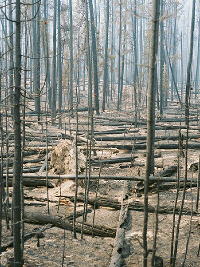
| Another view of the aftermath of recent fire at Gibbon Falls picnic area (W) 8-31-88 |
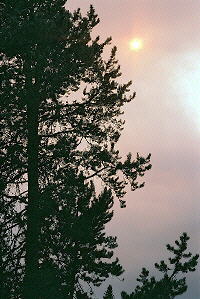
| The afternoon sun filtered through smoke along the shores of Yellowstone Lake (Tu) 8-30-88 |
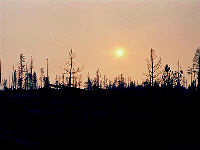
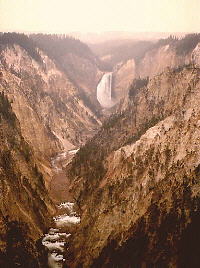
| Grand Canyon of the Yellowstone from Artist Point, thick with the haze of brown smoke. (Su) 9-4-88 |
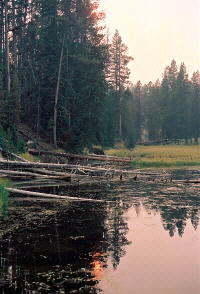
| Near Bridge Bay on Gull Point Drive (Su) 9-4-88 |
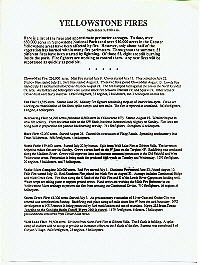
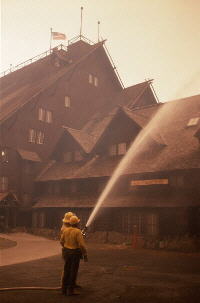
| I left the Old Faithful Inn before dawn on Sept. 7, not knowing that just hours later determined efforts such as this would help to save the historic structure. (W) 9-7-88 NPS Photo |
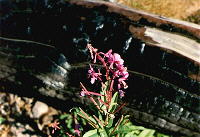
| Yellowstone Fireweed (1990) |
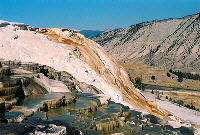
| Mammoth Hot Springs was literally a breath of fresh air on the day of my visit. It would be seriously threatened by fire in days to come. (Sa) 9-3-88 |
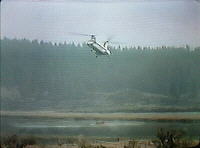
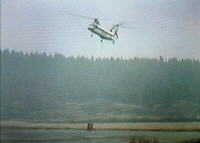
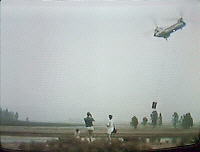
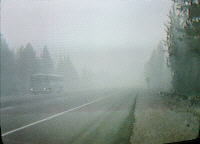
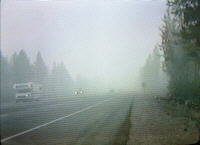
| Vehicles entering the south entrance of the park early Friday afternoon kept their lights on in the thick haze. (still images from home video tape) (F) 9-2-88 |
| Helicopter dips bucket into Yellowstone River, then flies on to fire area. (still images from home video tape) (Th) 9-1-88 |
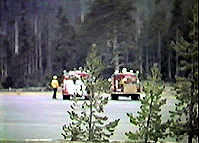
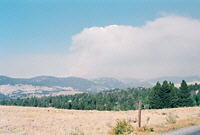
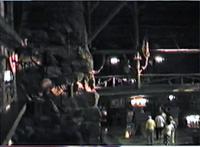
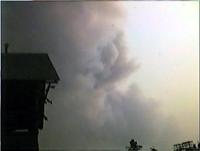
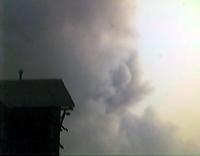
| By midweek fire trucks had began gathering in the parking lot behind the Old Faithful Inn in anticipation of worsening conditions later in the week. (still image from home video tape) (W) 8-31-88 about 7PM |
| As winds picked up during the day on Sept. 6, it was hard to ignore the smoke from the North Fork fire to the west, as seen here from the Old Faithful Area (still images from home video tape) (Tu) 9-6-88 |
| These two video captures only hint at the eerie yet strangely calm atmosphere in the Old Faithful Inn early on the evening of Sept. 6, as orange from the setting sun filters through smoke onto the fireplace.The next day shifting winds, a recently installed sprinkler system, and valiant efforts of firefighters and park employees would all help to prevent this from being a parting view of the Old Faithful Inn (still image from home video tape). (Tu) 9-6-88 |
| Cloud of smoke rises above the landscape along drive from Mammoth to Canyon. (Sa) 9-3-88 |
| Late afternoon sun tinted by smoke in the "blowdown" area between Canyon and Madison Junction . (Sa) 9-3-88 |
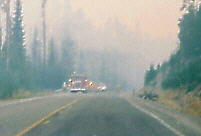
| Fire truck restricts traffic on the south entrance road into one lane as water is pumped through a leaky hose into the woods (click for larger view) (F) 9-2-88 |
| Regular fire updates and forecasts such as this one for 8:00 AM Sept. 5, 1988 were distributed at visitor centers for the press and public alike. (Please click on image for larger view) (M) 9-5-88 |
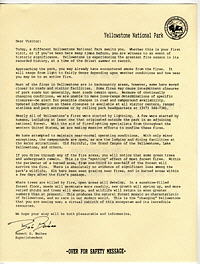
| At the east entrance, this letter from park superintendent Bob Barbee was handed out preparing the visitor for the unusual conditions in Yellowstone during the summer of 1988. (Click for larger view) (Tu) 8-30-88 |
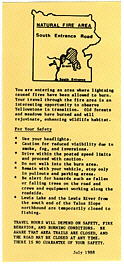
| Motorists entering the park at the south entrance were handed this flier (dated July 1988) advising of unusual fire conditions and precautions to take in this area of the park. (F) 9-2-88 |
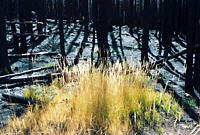
| (1989) |
| a new beginning . . . |
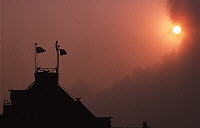
| The roof of the Old Faithful Inn is silhouetted against an ominous smoke column from the approaching North Fork fire, as seen here on Sept 6. We knew that what had come to seem inevitable could no longer be delayed. (Tu) 9-6-88 NPS Photo |