| Yellowstone - July 1941 page 5 |

| From Yellowstone, these travelers continued on by train to Salt Lake City and finally Colorado Springs. The last day of their trip was Aug. 4, 1941. |
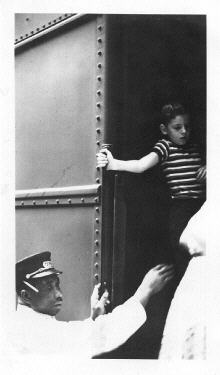
Our Pullman Porter for Entire Trip
(Edward in doorway) Aug. 2 - 1941
(Edward in doorway) Aug. 2 - 1941
July 1941 - A Closer Look
THERE WERE TWO big stories in July 1941. Beginning on May 15, the Yankees' Joe DiMaggio began a hitting streak that would
last for more than two months. On July 1, he broke Willie Keeler's 44 game record, and the nation tuned in faithfully to find out
just how long the streak could last. It finally ended on July 17th after 56 games, earning DiMaggio the nickname "Joltin' Joe".
The other big story was the inevitability of World War II and America's likely involvement in it. On July 19, 1941, England's Prime
Minister Sir Winston Churchill introduced the world to his two-fingered "V" for victory campaign. Three days later the Germans
temporarily halted their month-long offensive operations in the USSR because of troop exhaustion. General Douglas MacArthur
was named commander of U.S. forces in the Philippines on July 26. That same day, President Franklin D. Roosevelt broke off
U.S. relations with Japan, ordered Japanese assets frozen, and began an embargo on oil exports to Japan.
Early in 1941 the Andrews Sisters first harmonized to "Boogie Woogie Bugle Boy". Glenn Miller's 1941 movie "Sun Valley
Serenade" had Americans dancing to "Chattanooga Choo Choo", and in July "Take the A Train" joined the world of swing music.
July also saw the appearance of Humphrey Bogart as detective Sam Spade in "The Maltese Falcon". And though they might
have paid little notice to it, Americans saw the term "disc jockey" used for the first time in the July issue of Variety magazine.
Most Americans were probably not yet aware of some developments in July 1941 that would change their lives forever. This
was the month that freeze-dried mold cultures known as penicillin were introduced to the world. And on July 1, 1941 commercial
television was authorized. Within hours the first TV news broadcast (Lowell Thomas), TV game show (Truth or Consequences),
and TV commercial (for Bulova Watches) appeared. This infant technology would have to wait until the war ended before it could
take radio's place in American homes and hearts.
In 1941 Ansel Adams, then 39, was hired by the United States Department of the Interior to photograph America's national
parks for a series of murals celebrating America's natural heritage. By the time the outbreak of World War II caused the project
to be suspended less than a year later, Adams had captured some of his most memorable black-and-white images of
Yellowstone, Yosemite, and other national treasures that would help make him the legendary landscape photographer he has
become.
YELLOWSTONE SET AN all-time attendance record in 1941 with 581,761 visitors. But when America entered the war that
December, not even Wonderland could escape the effects. Visitation in 1942 was about 1/3 that of the previous summer.
Though the yellow tour buses continued to run, sightseeing trips were suspended. Lake Hotel and all park lodges closed. Gas
and tire rationing in 1943-1945 reduced Yellowstone's visitors to mainly local fishermen and occasional cross-country travelers.
Concessions made little attempt to improve facilities during the war years, and major projects like paving the road between Old
Faithful and Craig Pass were put on hold until after the war. The first post-war summer of 1946 brought an unexpected wave of
tourists--about 1-1/2 times that of 1941. Yellowstone was unprepared, and possibly has never been able to comfortably meet the
demands of the steadily increasing number of tourists it has seen since then.
THERE WERE TWO big stories in July 1941. Beginning on May 15, the Yankees' Joe DiMaggio began a hitting streak that would
last for more than two months. On July 1, he broke Willie Keeler's 44 game record, and the nation tuned in faithfully to find out
just how long the streak could last. It finally ended on July 17th after 56 games, earning DiMaggio the nickname "Joltin' Joe".
The other big story was the inevitability of World War II and America's likely involvement in it. On July 19, 1941, England's Prime
Minister Sir Winston Churchill introduced the world to his two-fingered "V" for victory campaign. Three days later the Germans
temporarily halted their month-long offensive operations in the USSR because of troop exhaustion. General Douglas MacArthur
was named commander of U.S. forces in the Philippines on July 26. That same day, President Franklin D. Roosevelt broke off
U.S. relations with Japan, ordered Japanese assets frozen, and began an embargo on oil exports to Japan.
Early in 1941 the Andrews Sisters first harmonized to "Boogie Woogie Bugle Boy". Glenn Miller's 1941 movie "Sun Valley
Serenade" had Americans dancing to "Chattanooga Choo Choo", and in July "Take the A Train" joined the world of swing music.
July also saw the appearance of Humphrey Bogart as detective Sam Spade in "The Maltese Falcon". And though they might
have paid little notice to it, Americans saw the term "disc jockey" used for the first time in the July issue of Variety magazine.
Most Americans were probably not yet aware of some developments in July 1941 that would change their lives forever. This
was the month that freeze-dried mold cultures known as penicillin were introduced to the world. And on July 1, 1941 commercial
television was authorized. Within hours the first TV news broadcast (Lowell Thomas), TV game show (Truth or Consequences),
and TV commercial (for Bulova Watches) appeared. This infant technology would have to wait until the war ended before it could
take radio's place in American homes and hearts.
In 1941 Ansel Adams, then 39, was hired by the United States Department of the Interior to photograph America's national
parks for a series of murals celebrating America's natural heritage. By the time the outbreak of World War II caused the project
to be suspended less than a year later, Adams had captured some of his most memorable black-and-white images of
Yellowstone, Yosemite, and other national treasures that would help make him the legendary landscape photographer he has
become.
YELLOWSTONE SET AN all-time attendance record in 1941 with 581,761 visitors. But when America entered the war that
December, not even Wonderland could escape the effects. Visitation in 1942 was about 1/3 that of the previous summer.
Though the yellow tour buses continued to run, sightseeing trips were suspended. Lake Hotel and all park lodges closed. Gas
and tire rationing in 1943-1945 reduced Yellowstone's visitors to mainly local fishermen and occasional cross-country travelers.
Concessions made little attempt to improve facilities during the war years, and major projects like paving the road between Old
Faithful and Craig Pass were put on hold until after the war. The first post-war summer of 1946 brought an unexpected wave of
tourists--about 1-1/2 times that of 1941. Yellowstone was unprepared, and possibly has never been able to comfortably meet the
demands of the steadily increasing number of tourists it has seen since then.

| (All photos on these pages from the collection of F.Markley, and may not be reproduced without consent.) |